Letting my special needs daughter be imperfect

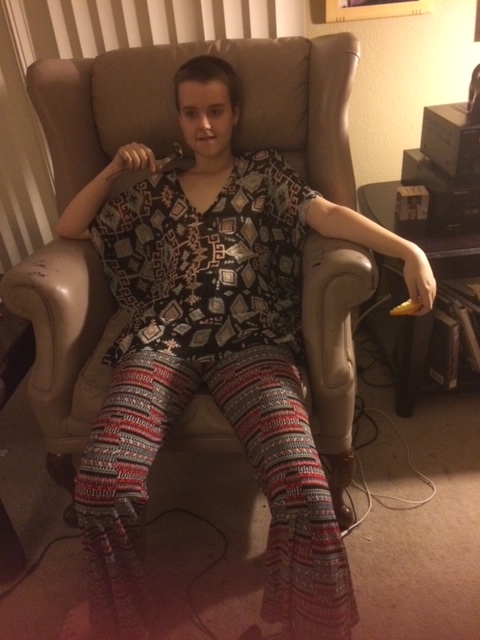
anna in chair

By the time I was my daughter’s age (12), I had gotten into loads of mischief.  Things that no one in my family would ever know and that I hope my closest friends will take with them to their graves.  But my daughter has no such liberties as I had.  She is constantly supervised, and the adult standard for her, the standard to which she is constantly held, is a behavioral standard that few neurotypical kids have to meet.  Am I the only one who, when my parents called up the stairs “did you brush your teeth?” lied and said I had because I was too lazy to get back up out of bed?  But Anna has me (or another adult) there every night to make sure.  There are lots of things that she does wrong, but all of it is in the light of day, under watchful, supervisory eyes.  So now and then, I like to let her believe that she has gotten away with something, sneaking a cookie into bed (I know, ick) or grabbing a spoonful of ice cream before dinner.

Dentists

I could not believe it when I found out how dental work usually gets done for kids with autism.  The dentist told me that they would be putting Anna under a general anesthetic to give her a filling and that it was likely that they would always have to do that.

Longfellow Pediatric Dentistry’s Dr. Padilla had a great idea.  She asked us to come and see her every three months, even though Anna didn’t need to.  Every time we came, she put Anna in the chair, had her lean back, opened her mouth to look in, and then lavished her with praise.  I would then take her out for a treat immediately after.  We have not had to put her under since then, and she’s relatively good with the dentist.

However, Anna has also needed extensive orthodontic work.  The orthodontist is fine, but not gifted at working with Anna.  She does ok with the various procedures, but sometimes we have to lie on top of her to get her to hold still.  This sounds worse than it ends up being, since Anna finds the pressure quite calming and immediately ceases any resistance and becomes quite calm, still, and cooperative in opening her mouth, shutting it, and biting down when requested by the orthodontist.

Do you know any good providers in the east valley?  Do you have any successful practices to share?

Hormones

For years, I described my daughter as “high-functioning.”  There were times when I read descriptions of some of the more extreme behaviors autistic children can have and thought that we were relatively lucky.  Then, at 10 years old, Anna got her period, and our luck ran out.

As her behaviors got more and more aberrant, extreme, and violent, I sought help from every quarter, even considering options that we had previously rejected (maybe hyperbaric oxygen tanks aren’t so crazy after all).  More and more, as I typed in her symptoms, catatonia came up, and I will provide a separate post about that.

During this journey, it has also been clear that hormones have played a role, and the fact that Anna is a girl with a condition that is predominately male has me reflecting on the dearth of material available regarding hormone fluctuations and the unique challenges of having a girl with autism.

Anna is not able to tell me when she has it, I just have to prowl around the bathroom when it’s due.  Her complexion has become extremely bad, worse than mine, my son’s, or my husband’s ever was.  We are taking her to a pediatric gynecologist for an exam.  We are also working with two developmental pediatricians and her regular pediatrician.

I spoke with one mom who had me a bit horrified when she explained that she medicates her daughter so that she never has a period.  My impression at the time was that it was a matter of convenience, because her daughter is completely nonverbal.  However, our pediatrician has explained that the hormonal fluctuations can be a particular problem for girls with autism, so we might want to look into it.

I spoke with another mom who called her daughter’s adolescence “the hormonal holocaust,” and shared how glad she was that her daughter has gotten past it and is in her 20s.  I appreciated the ray of hope.

My daughter has become aggressive, violent, and extremely noncompliant.  She elopes often and has an extreme penchant for shaving her head, which she does the way a butcher would.  She is an inch shorter than me and we are evenly matched when push comes to shove, so there have been times when it took everything that I had to prevent her from doing something dangerous.

What have we tried?  Several pediatricians have recommended SSRIs, but she responds very badly to them, with extreme mania.  She seemed to respond well to Intuniv initially, but I could not get her to stop chewing them.  She is now taking small doses of guanfacine, and it is too recent to tell whether it is the right thing.  We notice that her communication is clearer and her vocabulary is broadening.  So is that because we took her off of the Intuniv?  Because we put her on the guanfacine?  Or a completely random coincidence?

January, Daughter

My son has posted a poem by Billy Collins about his daughter, reminding me of another poem that I fell in love with years ago.  Anna’s birthday is in January, so this poem by Sharon Olds has always held a special significance:

January, Daughter

The last night before you were born, you were
almost complete, your mind busy,
without language, but full of motion
which would never be remembered or know itself.
The last night that you did not exist,
nine months before that–
from here it looks almost impossible,
our path to you and not one of the others.
If we had to go back and find you again,
like families looking for each other after war–
it frightens me how close we came
to missing you. If we had not walked down that
beach, if that side of the island had not been
deserted…Like a violent, delicate job of
rescue we got you out. Again, we’re in the
month of Saturn, its rings coiled loose around its
body, glittering disks of dust which we would
step through if we gave our weight to them, yet we
walked across them and stood at the moment of your appearing.

without gloves

It is hard to feel ready for this.  I wasn’t ready on the day that I got the diagnosis.  I wasn’t ready on the day that the support coordinator asked us what our goals were for Anna. And there is something every single day that catches me feeling unready for the task of parenting a girl with autism.

Many years ago, on a brief, ill-fated experiment with being a girl scout, I remember standing in the staging area, waiting for the parade to start.  All of us were lined up in our uniforms, and my friend looked down at my hands.  “Where are your gloves?!” she asked.  As I looked at the troop of girls with their gloves on, and my naked hands, the music started, our march began, and I went ahead without my gloves, not quite ready but on the move anyway.

I think of other parents of special needs girls and hope that this will be a helpful place for them. I hope it will be a helpful place for me, too. The march is on, the music is playing, ready or not.

Of course, there is another sense in which we use the phrase. A boxer might go without gloves against an opponent in a “bare-knuckle” fight. It is more intense, unmediated, without protection. Leaving off your gloves to punch a punching bag might toughen up your hands, strengthening muscles, connective tissue, bones… Yes.